Bulk Manage Google Workspace User Email Aliases

SheetOps Google Sheets Add-on
This guide is for the official SheetOps add-on. Install it to manage Google Workspace at spreadsheet speed.
Assigning secondary user email addresses, handling maiden name changes, and mapping domain alias handles for employee mailboxes in the Google Admin Console is slow and prone to errors. SheetOps provides visual staging in Google Sheets to bulk manage and diff-sync user email aliases across your organization.
Understanding User Email Alias Diff-Syncing
In SheetOps, user email aliases are managed via the Aliases column. SheetOps uses a diff-syncing model to process alias changes:
- Whatever email addresses are present in the Aliases cell when you apply changes will become the exact, complete set of aliases for that user.
- You do not need to specify "add" or "remove" actions. Simply edit the list so it reflects the desired end-state, and SheetOps will compute the difference (diff) between your spreadsheet and Google Workspace.
- Any email aliases added to the cell that were not there before are inserted.
- Any email aliases removed from the cell that were previously there are deleted.
- Untouched email aliases are left unchanged.
Google Admin Console vs. GAM CLI vs. SheetOps
To help you choose the best workflow for your needs, here is a comparison of the primary methods for bulk user email alias updates, including Google's native options and command-line tools like GAM CLI:
| Feature | Google Admin Console | GAM CLI (e.g., gam add alias) | SheetOps (Spreadsheet) |
|---|---|---|---|
| Workflow | Manual addition/deletion per user profile in Admin Console | Run CLI commands (like `gam create alias`) or loop through CSV scripts | Edit comma-separated lists in Google Sheets and tick checkboxes to sync |
| Skill Curve | Low (basic admin dashboard interface) | High (requires terminal familiarity, API setup, and scripting) | Low (leverages standard spreadsheet edits and mouse actions) |
| Visual Staging | None (updates apply immediately or via blind CSV processing) | None (commands run immediately without a visual review state) | Yellow highlights flag pending changes before committing them |
| Execution Logs | Checked via email reports or Admin Console Tasks dashboard | Standard terminal stdout/stderr logs | Real-time status updates directly in the sheet's Change Log column |
How to Bulk Add and Delete User Email Aliases
1. Prepare Your Spreadsheet Template
To target and update users, you have two options to bring them into the sheet:
- Fetch with Filters: Go to Extensions → SheetOps → Users, select Fetch with Filters, and choose your target criteria (such as a specific organizational unit) to bring existing users to the sheet. For a detailed guide on how to filter workspace users, refer to the filtering guide. Once imported, you can manage their email aliases.
- Just the Sheet: Go to Extensions → SheetOps → Users, select Just the Sheet, and click Create Sheet to generate a clean template. You can then simply input the user email and their target aliases before checking the Apply Changes checkbox.
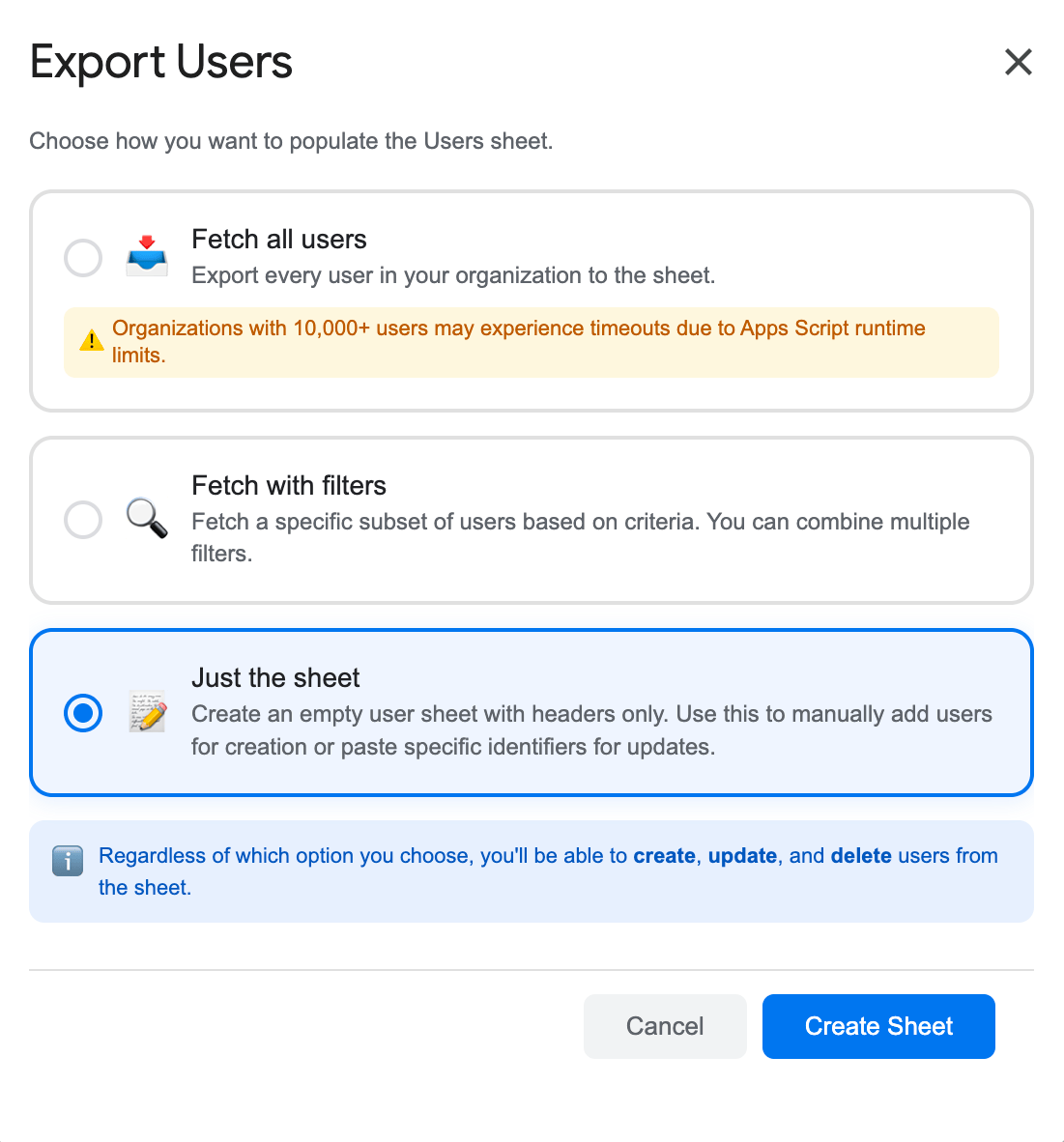
If the Aliases column is not visible in your sheet, go to Extensions → SheetOps → Choose display fields, select the Users tab, check the box for Aliases, and click Save.
2. Input Email Alias Changes
In the user sheet, locate the Aliases column:
- To add aliases: Append the new email addresses to the comma-separated list (e.g.
[email protected], [email protected]). - To remove aliases: Simply delete them from the comma-separated list.
- To clear all aliases: Make the cell completely empty.
- Edited cells will automatically highlight yellow.
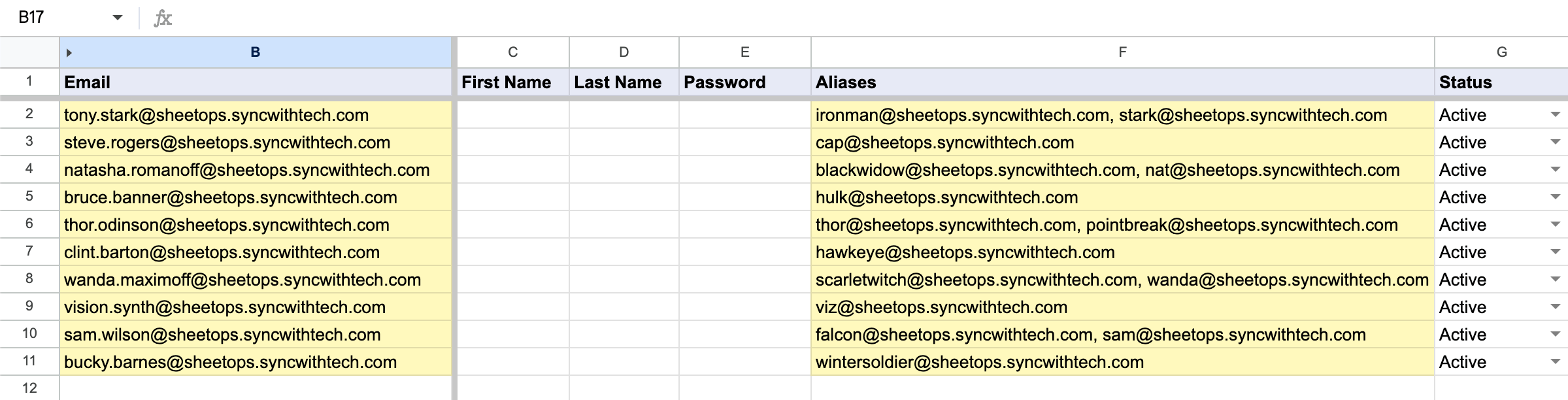
Whatever email addresses are listed in the Aliases cell will be the exact set of aliases that the user has after applying changes. SheetOps will automatically add any new aliases and remove any deleted ones to match this final list.
When you enter data, SheetOps automatically applies a yellow background to the edited cells. This visual indicator helps you keep track of pending changes before you push them.
3. Mass-Selecting User Email Alias Entries for Assignment
To check all user alias mapping rows for batch updates:
- Click the first checkbox cell in the Apply Changes column alongside your target user account row.
- Select all target user alias entries:
- Cursor Drag: Press and hold your left mouse button down while dragging across the checkbox cells.
- Shift + Click: Hold Shift on your keyboard and click the last user row in your list.
- Tap Spacebar to check all selected user alias checkboxes at once.
4. Executing User Secondary Email Alias Sync
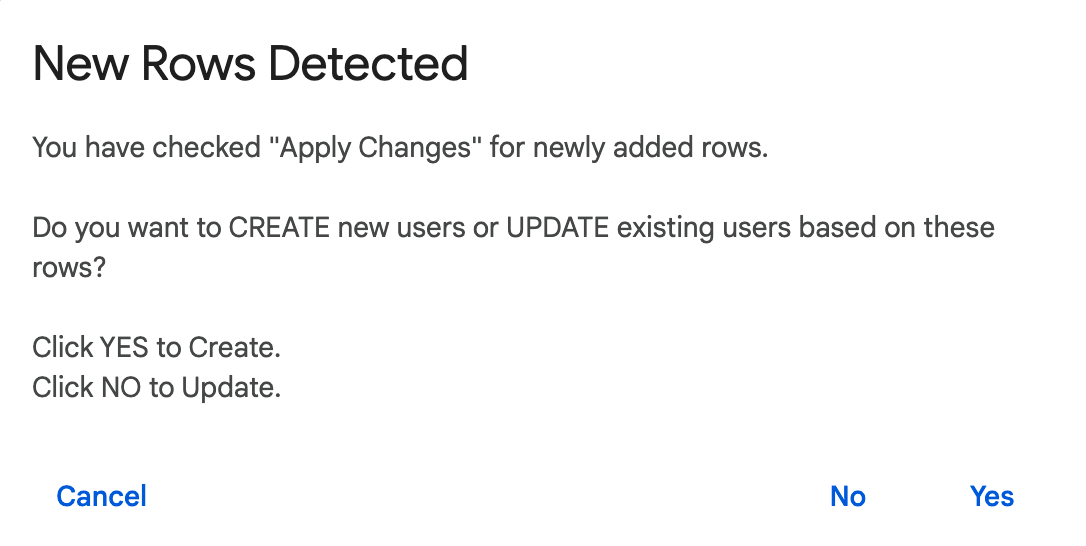
Hitting the Spacebar brings up the operational dialog. Select No (Update) to trigger the user alias synchronization flow. SheetOps compares cell values against current Google Workspace profiles, binding new secondary aliases (users.aliases.insert) and deleting removed handles (users.aliases.delete).
5. Reviewing User Alias Sync Status and Execution Logs
While SheetOps executes user alias diff-syncing in the background:
- Yellow edited cell highlights vanish as each user account's aliases update.
- The Change log column provides detailed execution results:
- ✓ Updated (highlighted in soft green) when the user email alias list syncs successfully.
- ✗ error_message (highlighted in soft red) if an alias handle exceeds the 30-alias per user limit or collides with another address.
Troubleshooting & Best Practices
- Alias Domain Verification: Any email alias you add must use a domain that is verified and active on your Google Workspace account. For details, refer to Google's guide on adding domain aliases.
- Uniqueness Requirements: An email alias must be unique. It cannot be assigned if it is already in use as a primary email, alias, or Google Group email by another entity in your Google Workspace domain.
- Google Workspace API Limits: Google Workspace enforces a maximum limit of 30 email aliases per user account. If you list more than 30 aliases in the comma-separated cell, Google's API will return a validation error. See Google's official user alias limits for more details.
Frequently Asked Questions (FAQ)
Can I bulk add email aliases using domains different from the primary domain?
Yes! As long as the secondary domain or alias domain is verified in your Google Workspace Admin Console, you can create aliases using it (e.g. [email protected] for a user whose primary email is [email protected]).
How does SheetOps handle alias deletions?
SheetOps uses a synchronization mechanism. If you delete an email alias from the comma-separated list in the spreadsheet, SheetOps detects the deletion relative to the baseline data and calls the Google Workspace Admin Directory API to remove that specific alias when you apply the changes.
What is the difference between an email alias and a Google Group?
An email alias belongs to a single user mailbox; all mail sent to the alias goes to that user. A Google Group (mailing list) distributes incoming mail to multiple users who are members of that group.
Last updated: June 18, 2026

Ready to manage Workspace at spreadsheet speed?
Install SheetOps from the Google Workspace Marketplace today and start performing bulk directory updates, onboarding, and audits directly inside Google Sheets.